Helping Children, Adults & Families Grow, Communicate & Thrive.
What paediatric OT actually does, and why “participation” is the outcome that matters most
When people hear “occupational therapy,” many assume it’s about helping adults return to a job. For children, “occupation” means something broader: the everyday activities that make up their world — playing, eating, dressing, writing, making friends, and simply keeping up at school. Paediatric occupational therapy (OT) is built around one central goal: helping a child participate fully in these everyday occupations, not just perform isolated skills in a therapy room.
The American Occupational Therapy Association describes occupational therapists as professionals who help people across their lifespan take part in the activities they want or need to do, using those everyday activities themselves as the therapeutic tool — commonly helping children with disabilities participate more fully in school and social situations through training in daily living skills and meaningful activities . For children specifically, this typically means an individualised evaluation to understand the child’s and family’s goals, a customised intervention plan, and ongoing review to confirm the child is making real progress toward their goals and to adjust the plan as needed .
In simple terms: an OT doesn’t just work on a skill in isolation. They look at three things together — what the child needs to do, what the child can and can’t currently do, and the environment the child is doing it in — and figure out where the mismatch is and how to close it.
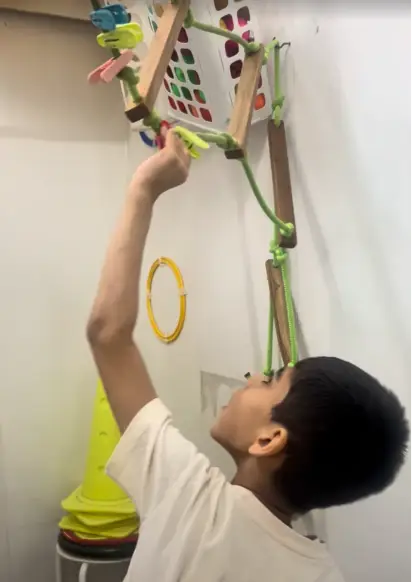
A useful way to understand OT’s purpose comes from the World Health Organization, which frames participation as involvement in the everyday life situations that matter for a person’s development, experience, and wellbeing — engagement in the occupations of daily life that are essential to growth and quality of life [1,2]. This idea has become central to how paediatric OT is practiced and measured. Rather than just tracking whether a child can grip a pencil correctly in a clinic room, OT asks whether that child can now keep up with in-class writing, join a game at recess, or manage getting dressed independently in the morning.
Research backs this up. A 2023 cohort study published in the journal Children looked at preschoolers with developmental disabilities receiving short-term occupational therapy and found significant improvements in the children’s sensory-motor abilities — including balance, visual integration, and fine motor precision — following the intervention, along with gains in independence and parental satisfaction [1]. Crucially, the study didn’t stop at motor scores — it concluded that the intervention was effective both in improving sensory-motor abilities and in promoting the children’s participation in daily activities [1], reinforcing that participation, not just isolated skill scores, is the outcome that matters.
Paediatric OT is broad by design. Depending on the child’s needs, therapy may target:
This range matches how OT is defined by children’s occupational therapy services more broadly: therapists work with children from birth to young adulthood to help them take part and manage in their everyday tasks and activities in a way that supports their development, health, and wellbeing, partnering closely with families and the wider team of professionals who support the child throughout [6].
One distinguishing feature of OT is that it doesn’t treat the child in isolation from their environment. It considers the activity itself, the child’s specific skills and challenges, and the setting the activity happens in — and works to bring all three into better alignment — managing the occupation the child needs to do, the skills the child does or doesn’t yet have, and the environment surrounding the activity [7]. When these three elements aren’t working together, a child may struggle with everyday tasks that seem simple to their peers — and the therapist’s role is to work with the child and family to close that gap so the child can participate and reach their goals [7].
This is also why OT rarely works in a vacuum. Effective paediatric OT typically involves close collaboration with parents, teachers, and other therapy disciplines (speech-language therapy, physiotherapy, special education) so that gains made in a session translate into real changes at home and school — not just in the clinic.
A common question parents ask is whether progress made in therapy sessions actually carries over into daily life. This is a well-studied concern in OT research. A study on children using the CO-OP (Cognitive Orientation to daily Occupational Performance) approach — a structured, problem-solving-based OT method — found that most children’s transfer goals improved by at least one level six months after the intervention, with the approach facilitating the transfer of newly acquired skills to new, untrained activities even after therapy had ended [3]. The same research also highlighted something many paediatric therapists see clinically: parent involvement appears to meaningfully influence how well children generalise these skills beyond the therapy setting [3]. In other words, OT works best as a partnership between therapist and family, not a service that happens only inside a clinic room.
Children are typically referred to OT when there’s a noticeable gap between what’s expected of them and what they’re currently able to do independently — often first noticed by parents or teachers. This includes children with diagnosed developmental disabilities as well as children without a formal diagnosis who are simply struggling to keep pace with the everyday activities expected of them [1]. Common reasons for referral include difficulty with handwriting or classroom tasks, sensory sensitivities that disrupt daily routines, delayed self-care independence, coordination difficulties, or challenges with attention and self-regulation that affect play and learning.
Occupational therapy for children isn’t about isolated exercises — it’s about helping a child do the everyday things that make up childhood: playing, learning, eating, dressing, and connecting with others, as independently and confidently as possible. The research is consistent on this point: gains in underlying skills like motor coordination and sensory processing matter most when they translate into real participation at home, school, and in the community — and that translation is more successful when families are actively involved throughout the process.
This article is for general awareness and isn’t a substitute for individual clinical assessment. If you have concerns about your child’s development or daily functioning, consult a qualified paediatric occupational therapist.
Providing an integrated framework of speech, sensory, occupational, and psychological clinical care to empower families and foster long-term developmental growth
Copyright © 2026 BE4 Therapy Clinic. All Rights Reserved. Developed by Web Creators India