What “Personalised” Actually Means
Personalisation isn’t just slower pacing or fewer questions on a page. It means:
- Starting from an accurate picture of the child’s current skills across motor, sensory, cognitive, and emotional domains
- Setting goals that are meaningfully challenging but achievable (not too easy, not overwhelming)
- Choosing the how — visual supports, movement breaks, hands-on materials, verbal vs. written instructions — based on how that specific child learns best
- Adjusting continuously as the child grows, rather than sticking to a plan written once and never revisited
This is the thinking behind Individualised Education Plans (IEPs) and their clinical equivalents in therapy settings — documents built around a single child’s profile, not a grade-level average.
The Evidence Behind It
A few well-supported principles show up again and again in the research on inclusive and personalised education:
- Universal Design for Learning (UDL) Developed by CAST, UDL argues that flexibility should be built into how material is presented, how children respond, and what motivates them — rather than retrofitting accommodations after a child struggles. Classrooms and therapy programmes that build in multiple ways to access the same skill see stronger engagement across a wide range of learners, not just those with diagnosed needs (Rose & Meyer, 2002; CAST, 2018).
- Scaffolding within the Zone of Proximal Development Vygotsky’s concept of the “zone of proximal development” — the space between what a child can do alone and what they can do with support — remains one of the most replicated ideas in developmental psychology. Tasks pitched in this zone, with support gradually withdrawn as competence builds, produce more durable learning than tasks that are too easy or too far out of reach (Vygotsky, 1978; Wood, Bruner & Ross, 1976).
- Strengths-based, rather than deficit-based, planning Research in special education consistently finds that framing goals around a child’s existing strengths — and using those strengths as the entry point for new skills — improves motivation, self-esteem, and generalisation of skills outside the therapy or classroom setting (Lopez & Louis, 2009; Buckley, 2016).
- Sensory-informed instruction For children with sensory processing differences, regulation has to come before learning — a dysregulated nervous system simply cannot attend, process, or retain information efficiently. Ayres’ Sensory Integration theory, and decades of occupational therapy research since, show that addressing sensory needs first (through movement, proprioceptive input, or environmental adjustment) measurably improves a child’s capacity to engage with academic or social tasks afterward (Ayres, 1972; Schaaf & Mailloux, 2015).
- Consistent, individualised feedback Meta-analyses on feedback in education (notably Hattie & Timperley’s influential 2007 review) find that specific, timely, individualised feedback has one of the largest effect sizes of any classroom intervention — far more powerful than generic praise or corrections.
What This Looks Like in Practice
In our own work with children across occupational therapy, speech-language, physiotherapy, and special education, personalisation shows up in small but deliberate choices:
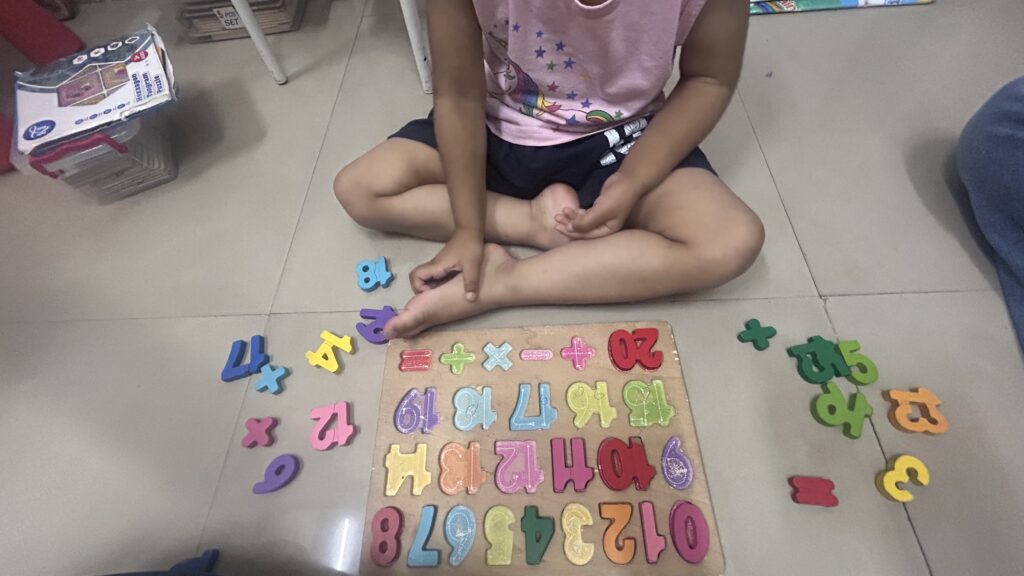
- A child who struggles with fine motor control might work on the same pre-writing goal as a peer, but through a completely different activity — perhaps building with clay before ever picking up a pencil.
- A child who becomes overwhelmed by verbal instructions might get the same task broken into a visual sequence instead.
- A child who needs movement to stay regulated might do their “seatwork” standing at an easel, or after a short sensory break — not despite the plan, but because of it.
None of these are shortcuts. They’re evidence-informed adjustments that respect how that particular child’s brain and body actually work.
The Confidence Piece Isn’t Separate — It’s the Point
Skill-building and confidence-building aren’t two different goals running in parallel. When a child is given tasks calibrated to their actual ability, supported just enough to succeed, and allowed to work through their own strengths, they experience something powerful: repeated, earned success. That’s what builds genuine confidence — not encouragement alone, but the lived experience of doing it.
Over time, this is what allows children to participate more fully — raising a hand in class, trying an unfamiliar playground game, attempting a task they once avoided — not because they were told to be brave, but because their history of small wins has quietly taught them that they can.
A Note for Parents
If you’re navigating this for your own child, you don’t need to become a therapist or teacher overnight. The most useful thing you can do is partner closely with whoever is working with your child — sharing what you notice at home, asking how goals are being individualised, and staying curious about why a particular approach is being used. Personalisation works best as a collaboration between professionals and family, not a plan handed down in isolation.
References
- Ayres, A. J. (1972). Sensory Integration and Learning Disorders. Western Psychological Services.
- Buckley, S. (2016). Strengths-based approaches in special education. British Journal of Special Education.
- CAST (2018). Universal Design for Learning Guidelines version 2.2. Wakefield, MA: CAST.
- Hattie, J., & Timperley, H. (2007). The Power of Feedback. Review of Educational Research, 77(1), 81–112.
- Lopez, S. J., & Louis, M. C. (2009). The Principles of Strengths-Based Education. Journal of College and Character, 10(4).
- Rose, D. H., & Meyer, A. (2002). Teaching Every Student in the Digital Age: Universal Design for Learning. ASCD.
- Schaaf, R. C., & Mailloux, Z. (2015). Clinician’s Guide for Implementing Ayres Sensory Integration. AOTA Press.
- Vygotsky, L. S. (1978). Mind in Society: The Development of Higher Psychological Processes. Harvard University Press.
- Wood, D., Bruner, J. S., & Ross, G. (1976). The Role of Tutoring in Problem Solving. Journal of Child Psychology and Psychiatry, 17(2), 89–100.